
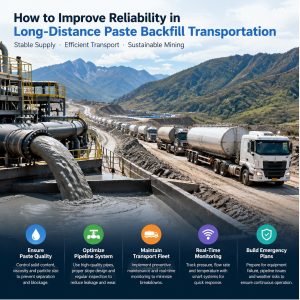
 A blocked paste line doesn’t announce itself politely. It sulks, pressures up, then stops a stope dead. At that point, everyone becomes a philosopher. Was the mix too dry? Was the pump undersized? Was that 3 km route always a bad idea? Long-distance paste backfill transportation has a way of exposing every weak assumption in your design, your operations, and your maintenance culture. Reliability is not a lucky charm you hang on the pump. It is a discipline.
If you are moving paste several kilometers underground, you are not just pumping tailings. You are managing a pressure vessel, a wear lab, a scheduling problem, and a data stream. The mines that get this right treat reliability as a system, not a spare part.
Start with rheology, not the pump curve. Paste is not concrete and it is not slurry. It lives in a narrow window where it can be pumped without segregating and still set strong enough underground. Yield stress, viscosity, particle size distribution, binder chemistry, water chemistry, and temperature all matter. A small change at the plant can turn into a huge pressure spike at the far end of the line. If your plant cannot deliver the same paste twice, no pump on earth will save you. Reliability begins with consistent feed. That means real lab testing, online rheology where possible, and mix control that reacts before the operator sees a pressure alarm.
Design the pipeline for the bad days, not the brochure days. Long distance means pressure. Pressure means wear, heat, and risk. Pipe diameter, wall thickness, route selection, bend count, booster station placement, and cleanout strategy are not details. They are the difference between a transport system and a recurring outage. Every unnecessary bend is a wear point. Every undersized flange is a future leak. Every missing pressure sensor is a blind spot. You want redundancy where it counts, whether that is a parallel line, a bypass, or a booster skid that can be swapped in without stopping the whole circuit. Instrumentation is not a luxury. Pressure, flow, density, and temperature data along the line give you the early warning that turns a catastrophic blockage into a controlled shutdown.
Booster stations deserve special suspicion. They are often treated as add-ons, but in long-distance paste transport they are the heart of the pressure profile. Piston pumps and positive displacement systems need synchronized control. If one booster trips and the next one keeps pushing, you get surge, water hammer, or a line full of dead paste. Variable frequency drives, auto ramping, pressure setpoints, and check valve logic must be engineered together. The control philosophy should answer a simple question: when something goes wrong, does the system fail safe or fail messy? Fail messy is expensive.
Wear is not linear. It accelerates at bends, joints, reducers, and anywhere the flow profile changes. The mines with reliable paste lines do not wait for a pin hole leak. They measure. Ultrasonic thickness testing, scheduled pipe rotations, wear-resistant materials in high-impact zones, and a spare parts strategy that matches actual consumption rates. Maintenance crews need to know what normal looks like. If they only see the line when it fails, they are always reacting. Condition monitoring turns maintenance from emergency surgery into planned work.
People are part of the pipeline. Operators need clear start and stop procedures. Flushing routines cannot be improvised. Shutdown planning has to include the backfill circuit, not just the mining cycle. Communication between the surface plant, the control room, and the underground crew must be tight. When a blockage happens, everyone should know who does what and in what order. Training simulators and regular drills are not overhead. They are insurance. Blaming the operator for a bad design is a waste of a good lesson.
Data is only useful if it changes behavior. Track pressure trends, flow rates, density, wear rates, and downtime by cause. Run root cause analysis on every significant event, not just the ones that make the shift report. Look for patterns. Does pressure creep up after a certain binder batch? Does flow drop when the ambient temperature changes? Does a particular bend fail every eight months? A digital twin or simulation model can help, but only if the underlying data is clean and the team acts on it. Otherwise it is just expensive decoration.
If you are buying pumps, pipes, or consulting, do not buy boxes. Buy reliability. Ask vendors for references in long-distance paste backfill, not just any slurry application. Ask for total cost of ownership models, wear life guarantees, commissioning support, and training plans. A good partner will ask about your ore body, your tailings, your route, and your shutdown windows before quoting a pump. That is a sign they understand the problem. A bad partner will quote a pump and wish you luck.
Reliability in long-distance paste backfill transportation is not a single upgrade. It is a chain of decisions that starts with the tailings and ends with the stope. Get the rheology right. Design for pressure and wear. Control the boosters. Measure the line. Train the people. Learn from the data. Then choose partners who have done it before and will stay through commissioning and beyond. Fewer blocked lines and more tonnes placed are not accidents. They are engineered. If your paste line is a recurring headache, bring in a team that treats the whole transport chain as one system. The cost of a blocked line is always higher than the cost of getting the design right.