 A DTG print that cracks after three washes isn’t a printing problem; it’s a promise problem. The customer bought a shirt that looked custom, felt soft, and seemed worth the premium. Then the laundry turned it into a faded, cracked mess. That’s how returns start, reviews go south, and reorders dry up.
If you print DTG on cotton, wash durability is the line between a novelty and a product. The good news: it’s rarely one magic additive. It’s a chain. Fabric, pretreatment, ink, print settings, curing, handling, and even the care tag all pull on the same rope. Break one link, and the whole print suffers.
Start with the cotton itself. Not every cotton tee behaves the same under DTG ink. Ring-spun, combed cotton gives you a smoother surface and better ink reception than rough, open-end carded cotton. Heavier doesn’t always mean better, but a tight, consistent knit helps the ink sit where it belongs instead of sinking into a fuzzy surface. If the fabric has a lot of sizing, softener, or silicone finish, pretreat and ink may struggle to bond. Ask your blank supplier for wash-tested DTG recommendations. If they can’t answer, that’s a red flag.
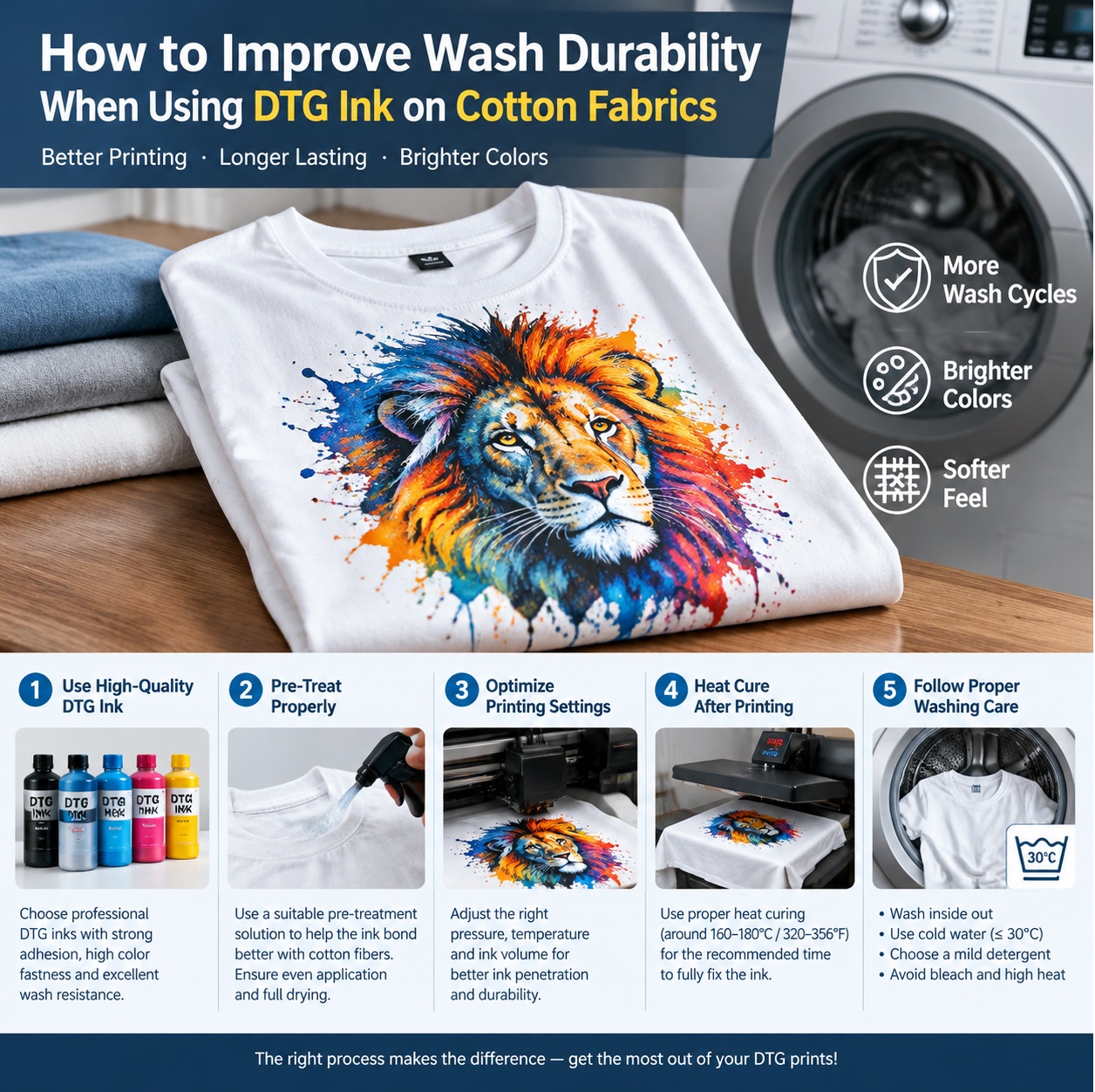
Pretreatment is where many shops leave money on the table. DTG ink on cotton needs a proper pretreatment to control bleeding, improve color yield, and give the pigment something to grip. The mistake is treating it like a checkbox. Too little pretreat, and the print looks weak and washes out. Too much, and you get yellowing, a stiff hand, and sometimes worse wash fastness because the chemistry is out of balance. Use the pretreat made for your ink system, apply it evenly, and dial in the wet pick-up. A spray gun, roller, or auto pretreat machine can all work, but consistency matters more than the tool. Dry the pretreat completely before printing. If the shirt feels damp or cool, stop.
Ink quality matters, but so does ink management. Shake white ink properly. Check expiration dates. Store inks at stable temperatures. Keep the printhead clean and run daily maintenance. A clogged or misfiring nozzle can lay down uneven ink, and uneven ink cures unevenly. For cotton DTG, you want an ink set with a strong binder package and a reputation for wash fastness, not just vivid colors on day one. Cheap ink can look great in the shop and fail in the laundry.
Print settings are another quiet culprit. More ink is not more durable. In fact, flooding the shirt with white underbase and color can create a thick, brittle film that cracks when the cotton flexes. Work with your RIP profiles. Use the right white underbase for the fabric color, control ink limits, and avoid over-saturating dark shirts. If you’re printing on a dark cotton tee, a good white underbase is necessary, but it should be smooth and controlled, not a paint layer. Let the software and test prints guide you.
Curing is the make-or-break step. DTG pigment ink needs heat, time, and pressure to form a durable film. Under-cured ink will wash away, fade, or crack. Over-cured ink can scorch, yellow, or become brittle. Follow your ink manufacturer’s cure window. Many systems land around 320°F for 30 to 60 seconds with medium pressure, but that is not a universal law. Some inks need a tunnel dryer at a longer dwell. The only way to know is to test. Use a heat press with accurate temperature and even pressure. If you use a tunnel dryer, verify the actual garment temperature, not just the display. And never cure a damp print. Moisture trapped under the ink turns to steam and sabotages the binder.
Handling after curing is often ignored. Let the print cool completely before stacking or folding. Hot prints can stick to themselves, pick up texture, or distort. Don’t fold directly across the print for storage. If you ship shirts in poly bags, make sure they’re fully cool and dry. Small things like this protect the cure you just worked for.
Then there’s the wash test. You cannot claim durability you haven’t measured. Wash test like your customer will: inside out, cold water, mild detergent, no bleach, no fabric softener, tumble dry low or hang dry. Run 5, 10, and 20 cycles. Check for cracking, fading, color bleed, and hand feel. If you want to get serious, use standardized wash tests or a third-party lab. But even a simple in-house wash log will reveal more than a hundred opinions. Test each new blank, each new pretreat batch, and each new ink lot. That’s how you catch drift before your customers do.
Your care instructions are part of the product. A great DTG print can still fail if the customer washes it in hot water, dries it on high, or irons directly on the print. Include a simple care tag or insert: wash inside out, cold, mild detergent, no bleach, no fabric softener, tumble dry low or hang dry. That’s not asking too much. It’s protecting the experience you sold.
Here’s the marketing side, because this is not just a production issue. Wash durability is a selling point. When your DTG cotton shirts survive real life, you can charge more, reduce returns, and build a brand that people trust. You can tell buyers, “This print is made to last,” and mean it. You can show wash-test photos. You can offer a satisfaction guarantee. You can stop competing on the lowest price and start competing on reliability.
So audit your chain. Fabric. Pretreat. Ink. Print. Cure. Handle. Wash test. Care tag. If one step is sloppy, fix it. If your ink supplier only sells you bottles and not process support, find a better partner. The shops that win with DTG on cotton aren’t the ones with the flashiest printer. They’re the ones who treat wash durability as a promise, not an afterthought.
Comments closed A blocked paste line doesn’t announce itself politely. It sulks, pressures up, then stops a stope dead. At that point, everyone becomes a philosopher. Was the mix too dry? Was the pump undersized? Was that 3 km route always a bad idea? Long-distance